
Fitness
Tennis After 50: Playing Well and Staying Injury-Free
How to keep playing good tennis after 50: adapting your game, the injuries that matter most, warm-up, strength work and managing your weekly load.

Jump to a section
Want to improve your game?
Private and group coaching with Claire Carter in Redwood Shores.
Book a lessonMore tennis guides
Technique, gear, fitness and match play, written from the coach’s chair.
Browse all guidesThere is a persistent idea that tennis after fifty is about managed decline. It is not. Plenty of players are tactically at their best in their fifties and sixties, because reading the game improves long after the sprinting slows.
What does change is the margin for error physically. Recovery takes longer, tissues tolerate less sudden load, and small niggles become long absences if ignored. Almost everything below follows from that.
General guidance, not medical advice. If you have a specific injury or health condition, speak to a doctor or physiotherapist.
01What actually changes
| What changes | Effect on court | Practical response |
|---|---|---|
| Slower recovery between sessions | Fatigue accumulates across a week | Two or three quality sessions, not four rushed ones |
| Reduced tissue tolerance | Overuse injuries appear more easily | Warm up properly; build load gradually |
| Some loss of explosive speed | Wide balls are harder to reach | Position better; anticipate earlier |
| Balance declines if untrained | Off-balance shots and fall risk | Single-leg work; it responds quickly |
| Experience keeps improving | Better shot selection and reading | Lean on it; play smarter, not harder |
That last row is not a consolation prize. Tactical understanding is a genuine weapon, and it is why a well-positioned sixty-year-old regularly beats a fitter opponent who runs everywhere.
02Warm up properly, every time
This is the single highest-value change available. Four minutes of gentle rallying is not a warm-up, and the strains that come from starting cold cost weeks, not days.
- Five minutes of easy movement: walking, jogging, side steps.
- Dynamic mobility: leg swings, hip circles, thoracic rotations, arm circles.
- Band work for the shoulders before you serve.
- Progressive hitting: mini tennis first, then baseline, then serves.
- Save static stretching for afterwards.
Ten minutes, and it doubles as the mobility work most players never do separately. The fuller programme is in this off-court tennis fitness training.
03The injuries worth knowing about
Injuries in older players are overwhelmingly overuse rather than acute. They build quietly over weeks, which is good news: caught early, most are manageable.
| Area | Typical problem | Common contributors |
|---|---|---|
| Elbow | Tennis elbow | Late contact; stiff strings; over-gripping |
| Shoulder | Rotator cuff irritation | Serving volume; no shoulder conditioning |
| Achilles | Tendon pain | Sudden increase in play; poor footwear |
| Knee | Arthritic flare or patellar pain | Load spikes; weak quadriceps |
| Lower back | Strain and stiffness | Serving arch; weak core; poor hip mobility |
The knee is the other joint that most often limits older players, and it has its own guide here: tennis knee pain and prevention. The elbow case is the most common of all and has its own detailed guide here: tennis elbow prevention and recovery. The general principle across all of them is the same, though: a small problem addressed in week one is a fortnight; the same problem ignored for a month is a season.
04Strength work matters more, not less
Muscle mass declines with age unless you actively train it, and that decline is what removes the protection around joints and tendons. Two short sessions a week makes a genuine difference.
- Single-leg work. Split squats and step-ups; tennis is played on one leg at a time.
- Hip and glute strength. Protects the knees and the lower back.
- Rotator cuff and upper back. Ten minutes with a band, twice a week.
- Core. Anti-rotation and anti-extension work rather than sit-ups.
- Balance. Single-leg holds; unglamorous and it improves fast.
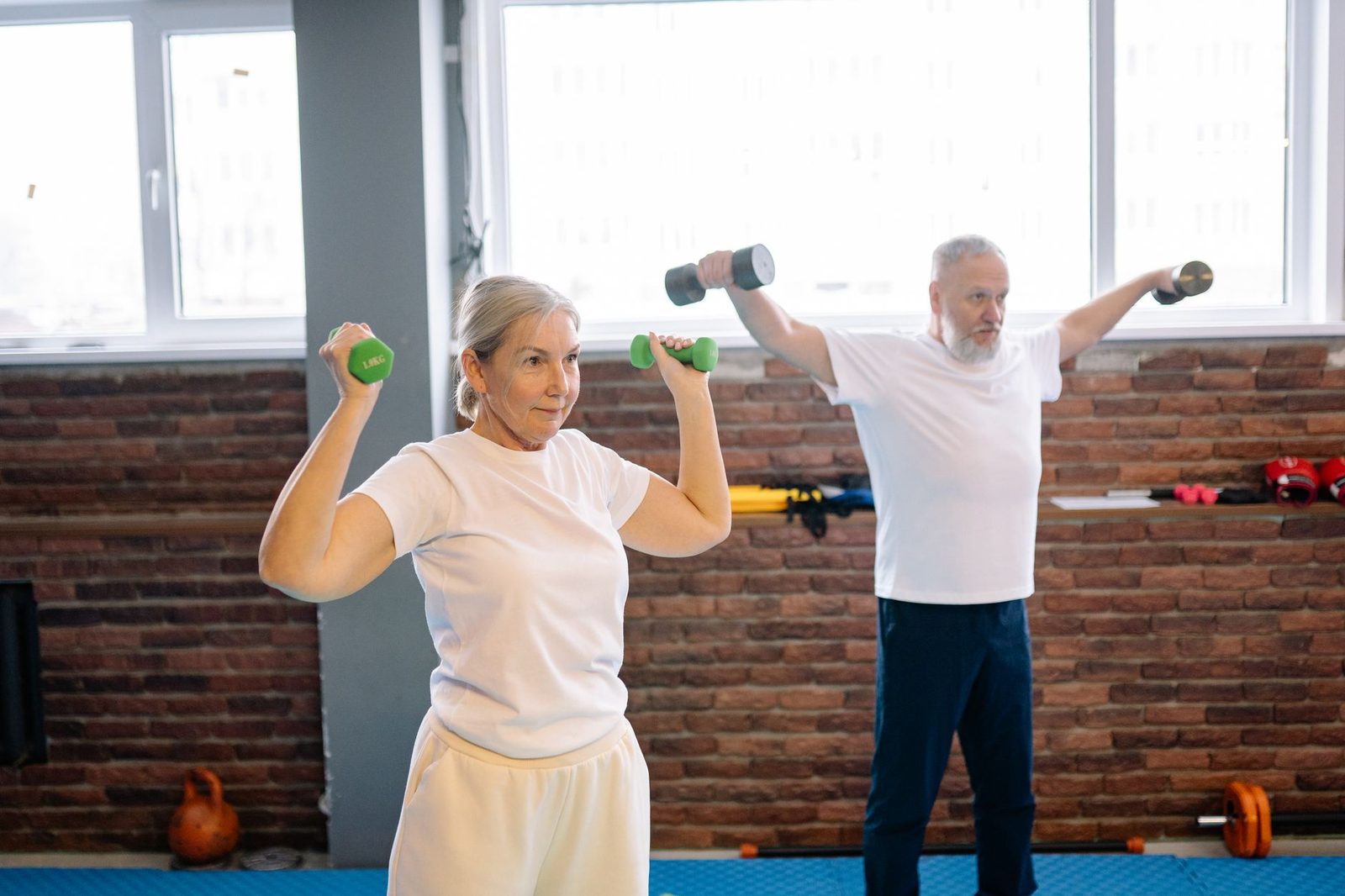
Nothing here needs heavy weights or a gym membership. Bodyweight, a band and a pair of light dumbbells covers it.
05Adapt the game, do not just endure it
The players who keep enjoying tennis into their sixties and seventies are usually the ones who changed how they play rather than trying to preserve a younger version of their game.
| Adaptation | Why it works |
|---|---|
| Play more doubles | Half the court to cover; more social |
| Improve positioning | Anticipation replaces sprinting |
| Use spin and placement | Puts pressure on without needing pace |
| Develop the slice | Low, awkward, and easy on the body |
| Come to the net more | Shortens points and reduces running |
| Serve for placement, not speed | Fewer shoulder problems; better percentages |
Pickleball is worth a mention here too, since it is lower impact and increasingly popular with players managing joints: this comparison of tennis and pickleball covers how the two interact. The slice in particular is a gift to older players: short motion, low physical cost, and genuinely difficult to attack. Details are in this slice backhand technique guide, and the net game that pairs with it is in these tennis volley drills.
06Doubles is not a downgrade
A lot of players resist the move to more doubles because it feels like an admission of something. It is worth reframing. Doubles is a different game with its own considerable tactical depth, and at club level it is where most of the sociable, competitive tennis actually happens.
It also asks different physical questions. Court coverage drops substantially, but reaction speed at the net matters more, and that is a quality which holds up well with age when it is trained. Players who move to doubles in their fifties often find they are competitive against considerably younger opponents for another two decades.
The positional fundamentals are in this guide to doubles court positioning, and the mixed format has its own guide here: mixed doubles strategy guide.
07Managing the week
Load management is the concept that matters most and it is simple: your body responds to the total of what you do across a week, not to any single session.
- Two or three tennis sessions with recovery days between them.
- Avoid back-to-back hard days, particularly after fifty.
- Build gradually after a break rather than resuming at your old volume.
- Treat a tournament or a league weekend as a spike and plan recovery around it.
- Cross-train on non-tennis days: walking, swimming, cycling.
Sleep and nutrition do more for recovery than any supplement, and hydration matters more with age because thirst becomes a less reliable signal. Practical detail is in this guide to tennis nutrition and hydration.

08Equipment worth reconsidering
- A softer, more flexible frame reduces shock through the arm.
- Lower string tension and a multifilament string are kinder than stiff polyester.
- Correct grip size; too small encourages over-gripping.
- Court shoes with genuine lateral support, replaced when the tread wears smooth.
- A slightly lighter racquet, if the current one arrives late when you are tired.
The full specification breakdown is in this guide to choosing a tennis racquet. For a clinical perspective on playing into later life, The Jackson Clinics has practical physiotherapy guidance for older players.
09Frequently asked questions
Yes. It combines cardiovascular work, balance, coordination and load-bearing movement, and it is sociable, which is one of the strongest predictors of whether people keep doing an activity. Studies of active older players generally find better musculoskeletal function than in comparable non-players.
Overuse problems rather than sudden trauma: tennis elbow, rotator cuff irritation, Achilles tendon issues, knee and lower back complaints. Because they build gradually, they respond well to early attention and badly to being ignored.
Adapting usually beats resisting. Doubles reduces court coverage, better positioning reduces sprinting, and spin and placement replace pace. Players who adapt tend to keep winning; players who try to play exactly as they did at thirty tend to get injured.
Most players do well on two to three sessions a week with genuine recovery between them, rather than four hard sessions back to back. Recovery capacity declines with age before ability does.
Yes, and it is the highest-value change most older players can make. Ten minutes of movement-based warm-up before playing substantially reduces the risk of the strains that end up costing weeks.

Claire Carter
Former WTA Tour Professional & Teaching Pro
Claire Carter is a former WTA Tour professional and a full-time teaching professional at Bay Club Redwood Shores, where she has coached juniors and adults for more than twelve years.
More about ClaireImage credits: Anna Shvets (Pexels), Christian Tenguan (Unsplash), Mario Spencer (Unsplash), Rezli (Unsplash), SHVETS production (Pexels), Yan Krukau (Pexels). Photographs are illustrative.