
Fitness
Tennis Knee Pain: Causes, Prevention and Recovery
Why tennis is hard on knees, what patellar tendinopathy actually is, how court surface and quad strength change your risk. Not medical advice.

Jump to a section
Want to improve your game?
Private and group coaching with Claire Carter in Redwood Shores.
Book a lessonMore tennis guides
Technique, gear, fitness and match play, written from the coach’s chair.
Browse all guidesKnees take more punishment in tennis than most players realise. The sport is essentially a few hundred rapid accelerations, abrupt stops and changes of direction, and the knee absorbs a large share of every one of them.
This is general information for players, not medical advice. If you have knee pain, see a doctor or physiotherapist for diagnosis. Nothing here replaces that.
01What tennis actually does to a knee
Running in a straight line is comparatively kind. What tennis adds is deceleration and rotation: stopping hard from a sprint, planting to change direction, landing from a serve, twisting through a groundstroke.
Those eccentric loads, where the muscle lengthens under tension to control the movement, are what the tendons and joint structures find hardest. Repeated over years, they are the source of most tennis knee complaints.
02Patellar tendinopathy, the common one
Often called jumper’s knee, this is pain in the tendon just below the kneecap. It develops from cumulative microtrauma and small tears associated with repeated eccentric loading of the quadriceps, and tennis sits among the higher-risk sports alongside volleyball and basketball.
The pattern is characteristic: it starts as a niggle after playing, progresses to pain at the start of a session that warms up and disappears, and eventually becomes pain that persists through the match. The earlier it is addressed, the shorter the story.
Physio-pedia maintains a detailed clinical overview if you want the underlying detail.
03Surface matters more than most players think
This is the finding worth acting on. Research into patellar tendinopathy has found substantially higher prevalence among athletes training on concrete compared with softer surfaces, with figures roughly in the region of 38 per cent versus 20 per cent.
| Surface | Impact on knees | Why |
|---|---|---|
| Clay | Lowest | Sliding dissipates force rather than transmitting it |
| Grass | Low | Softer underfoot; shorter points |
| Cushioned acrylic hard court | Moderate | Some give in the surface layer |
| Hard court over concrete | Highest | Abrupt stops with nothing absorbing them |
| Indoor hard | Moderate to high | Fast surface; frequent hard stops |
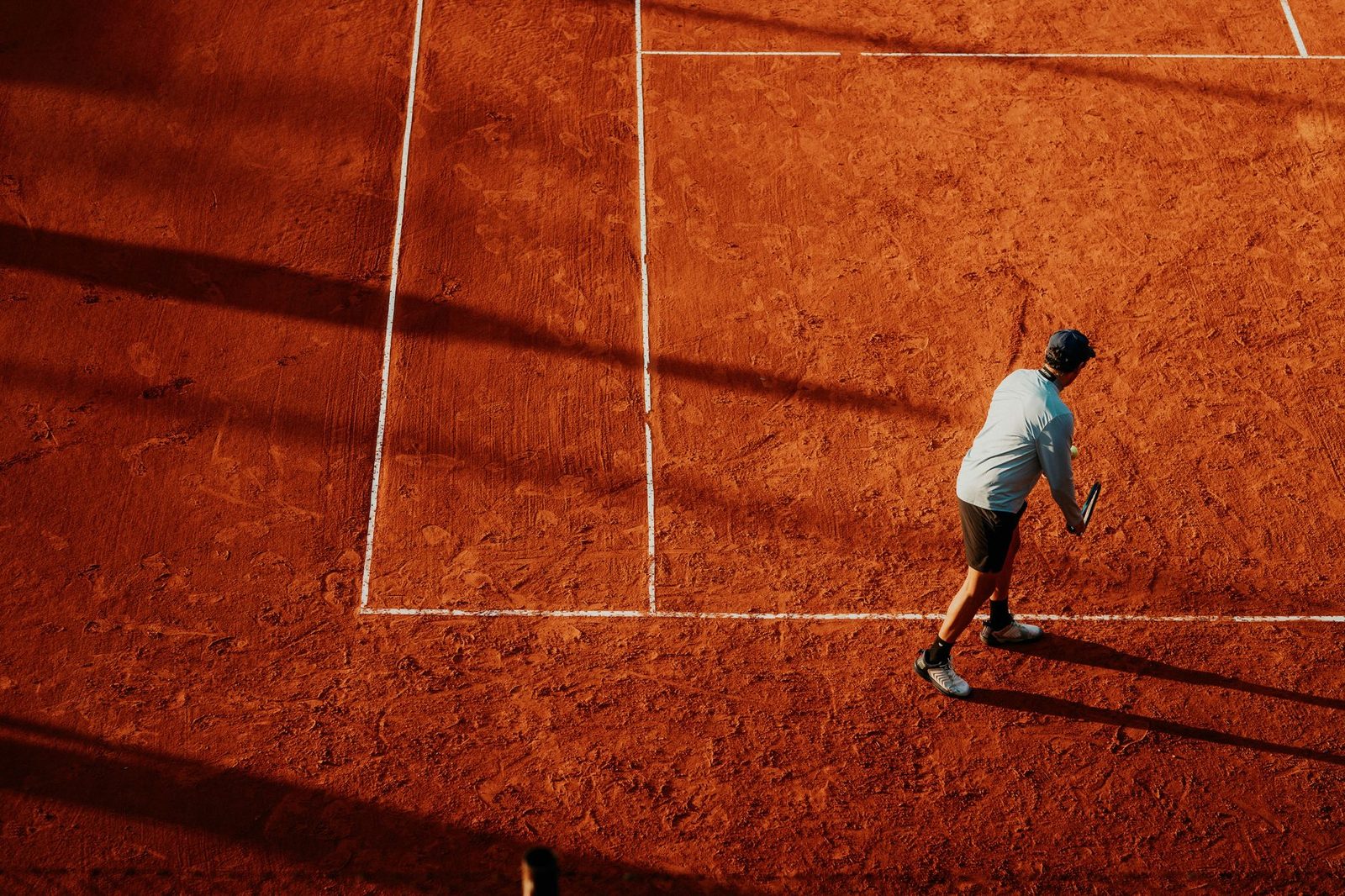
Most Peninsula public courts are acrylic hard courts, so this is not always a choice. But if you have knee trouble and clay is available occasionally, it is worth the drive. The differences between surfaces are set out in this guide to tennis court surfaces.
04Build the quadriceps
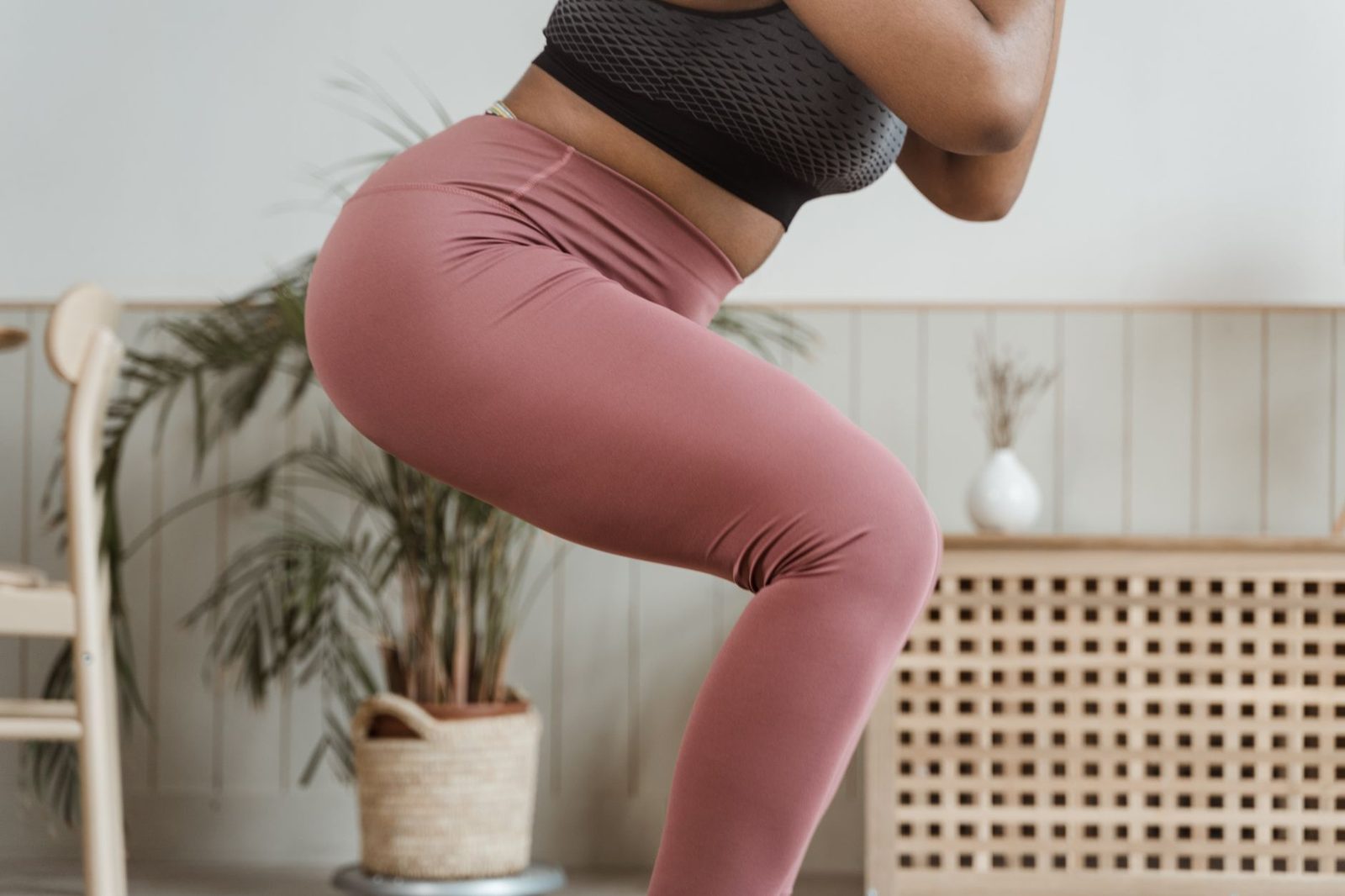
Quadriceps strengthening is the mainstay of both prevention and rehabilitation. Strong front-of-thigh muscles absorb loads that would otherwise pass into the tendon and joint.
- Squats. Bodyweight first, then loaded. Slow on the way down.
- Split squats. Single-leg, which is how tennis is actually played.
- Step-downs. Controlled lowering from a step; excellent eccentric work.
- Wall sits. Simple isometric hold; often well tolerated when sore.
- Decline squats. A specific rehabilitation exercise for patellar tendinopathy, best introduced on professional advice.
Slow on the lowering phase is the recurring instruction. Tendons respond to controlled eccentric loading, and rushing that phase wastes the exercise. The wider programme sits in this off-court tennis fitness training.
05Do not neglect hips and hamstrings
Knee pain frequently originates above or below the knee. Weak glutes allow the knee to collapse inward on landing and cutting, which changes how load passes through the joint. Tight quadriceps and hamstrings both increase strain on the patellar tendon.
- Glute bridges and hip thrusts for posterior chain strength.
- Lateral band walks for the muscles that stop the knee dropping inward.
- Hamstring work; a strong front and weak back is an imbalance.
- Quadriceps and hip flexor mobility, particularly if you sit at a desk all day.
- Calf strength, which shares deceleration load with the knee.
06Movement habits that protect the knee
Some of the load on your knees is technique rather than volume, and movement patterns are trainable in a way that court surface is not.
- Split step and land softly. A stiff, heavy landing sends force straight up the chain.
- Decelerate over several steps rather than one hard stop where you can.
- Turn with the whole body, not by twisting on a planted foot.
- Recover using small steps rather than one large lunge.
- Keep the knee tracking over the foot when you push off wide; collapsing inward is where trouble starts.
These are the same qualities that make you a better mover generally, which is why footwork practice is quietly also injury prevention. These tennis footwork drills cover the patterns.
07Load management, again
The same pattern shows up in the joints covered by this guide to tennis ankle and wrist injuries. As with the elbow and the shoulder, most knee problems in club tennis appear after a step change rather than out of nowhere: a new league, a tournament week, a sudden return after winter.
| Pattern | Risk | Better approach |
|---|---|---|
| Nothing all winter, then four sessions weekly | High | Rebuild over several weeks |
| Multiple matches in a day | High | Prepare with multi-match practice first |
| Steady two or three sessions weekly | Low | Maintain year-round |
| Adding singles after years of doubles | Moderate to high | Introduce gradually |
| Playing exclusively on hard courts | Moderate | Mix surfaces where possible |
The same principle applies as elsewhere: raise weekly volume gradually rather than in jumps. The elbow and shoulder versions of this are in tennis elbow prevention and recovery and tennis shoulder pain and prevention.
08Shoes and supports
Worn shoes are an underrated contributor. Once the cushioning has compressed, more impact reaches the knee, and the outsole wearing smooth also changes how you stop and pivot.
- Replace court shoes every six to twelve months for regular play.
- Cushioning matters more for knees than for any other part of the body.
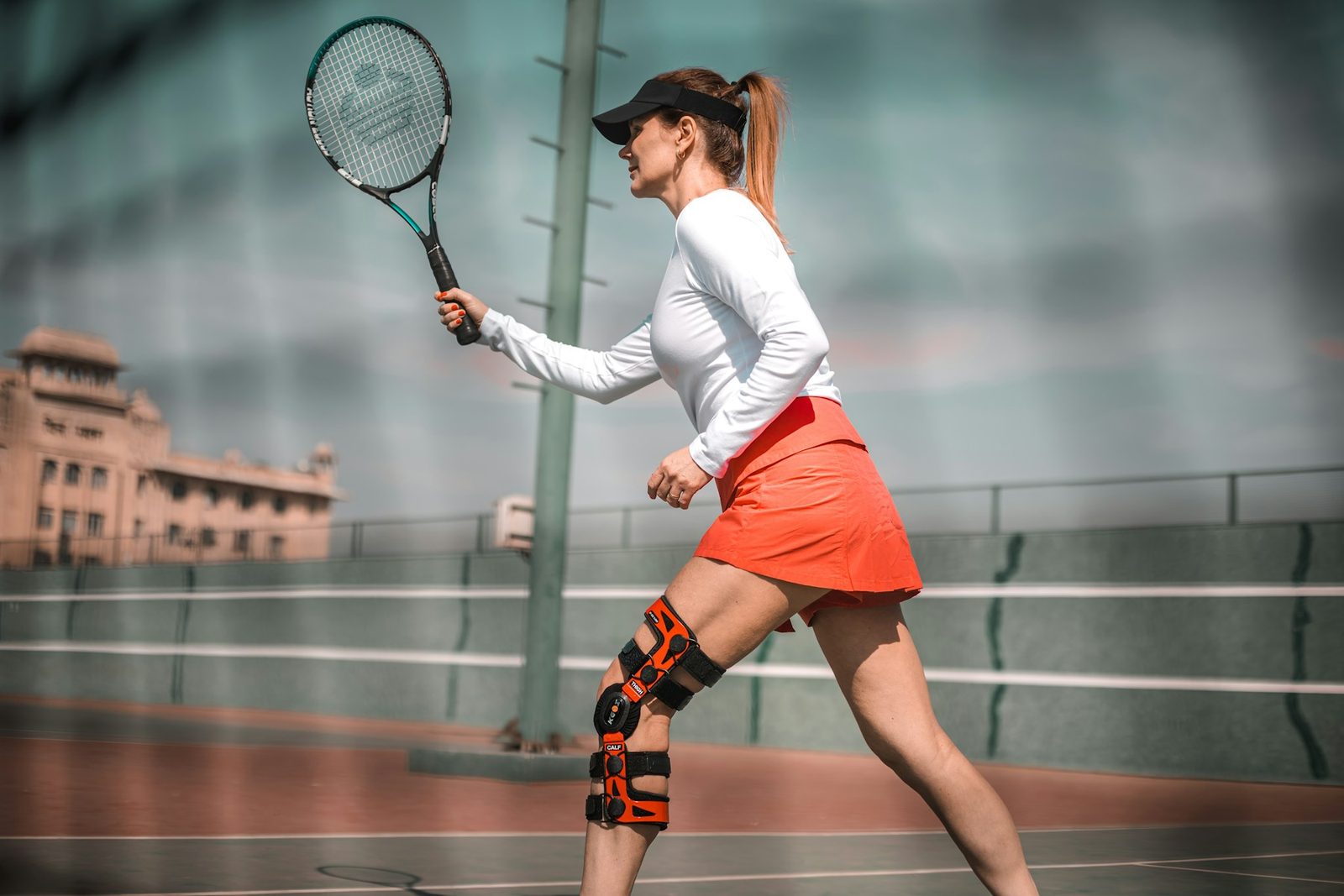
- A knee sleeve provides warmth and proprioceptive feedback; it is not structural.
- Taping can help symptomatically but does not fix the cause.
- See a professional about orthotics rather than self-prescribing.
The footwear side is covered in more detail in this guide to choosing tennis shoes.
09If it already hurts
Get it assessed properly. Knee pain has several distinct causes with genuinely different treatments, and the patellar tendon is only one of them.
What is broadly consistent is that these problems respond to progressive loading under guidance rather than to complete rest, and that continuing to play through significant pain extends the timeline. Reducing load early is almost always faster.
While you recover, most of the game remains available in modified form. Doubles reduces court coverage substantially, and there is plenty of technical work that does not involve sprinting. Returning gradually rather than resuming at your old volume is what prevents the second episode, and a private lesson in Redwood Shores can help rebuild sensibly once you have medical clearance.
10Frequently asked questions
Tennis involves constant deceleration, changes of direction and landing, all of which load the knee heavily. Hard courts amplify this because every stop is abrupt. Most knee pain in tennis is overuse rather than a single injury.
Patellar tendinopathy, a painful condition of the tendon below the kneecap caused by cumulative microtrauma from repeated loading. It is common in sports involving jumping, landing and rapid deceleration, which includes tennis.
Considerably. Research on patellar tendinopathy has found notably higher prevalence among athletes playing on concrete compared with softer surfaces. Clay is the kindest surface for knees because sliding absorbs force that a hard court sends up through the joint.
Quadriceps strengthening is the mainstay, particularly slow, controlled work. Hip and glute strength matters too, because weakness there changes how the knee tracks. Start on professional advice if you are currently in pain.
That is a question for a clinician. In general, playing through worsening knee pain tends to extend the problem, and reducing load early is usually faster than pushing on.

Claire Carter
Former WTA Tour Professional & Teaching Pro
Claire Carter is a former WTA Tour professional and a full-time teaching professional at Bay Club Redwood Shores, where she has coached juniors and adults for more than twelve years.
More about ClaireImage credits: Alora Griffiths (Unsplash), Brenda Rossato (Unsplash), Eagle Media Pro (Unsplash), Gera Cejas (Pexels), MART PRODUCTION (Pexels), Margo Evardson (Unsplash), Towfiqu barbhuiya (Pexels). Photographs are illustrative.