
Backhand
The One-Handed Backhand: Technique and Drills
How to hit a one-handed backhand: grip, shoulder turn, contact point out in front, and the high ball problem every one-hander has to solve.

Jump to a section
Want to improve your game?
Private and group coaching with Claire Carter in Redwood Shores.
Book a lessonMore tennis guides
Technique, gear, fitness and match play, written from the coach’s chair.
Browse all guidesThe one-handed backhand is the most admired and least advisable shot in tennis. It is beautiful, it reaches wide balls a two-hander cannot, and it flows naturally into slice and volleys.
It is also considerably harder to hit well, punishes a late contact point far more severely, and struggles with the high ball that modern topspin produces constantly. If you already have one, this is how to make it work. If you are choosing, read the honest comparison at the end first.
01The grip
An eastern backhand grip, with the base knuckle of your index finger on the first bevel for a right-hander. Your thumb often runs diagonally up the back of the handle for support, though some players prefer it wrapped.
This grip puts the racquet face square at a contact point well in front of your body, which is exactly where a one-hander has to be struck. A continental grip, the one you use for slice, will not work for a drive: the face opens and the ball floats.
02Turn early, and turn fully
The single biggest difference from a two-hander is how early you must prepare. With one arm and no second hand to stabilise the racquet, arriving late is not recoverable.
- Recognise the backhand and turn immediately, before the ball bounces on your side.
- Turn your shoulders so your back is partly visible to your opponent.
- Use your non-hitting hand on the throat of the racquet during preparation.
- Step across with your front foot, the right foot for a right-hander.
- Keep the racquet head above your hands as you take it back.
That non-hitting hand is doing real work. It holds the racquet during the turn, keeps the shoulders coiled, and then separates as you swing, acting as a counterbalance behind you.
03Contact point: the whole shot
A one-handed backhand must be struck further in front of the body than any other groundstroke. Not slightly further. Considerably.
The reason is structural. Your arm is extending away from your body, and it is only strong in that position when the contact is ahead of you. Meet the ball level with or behind your front hip and the arm is unsupported, the wrist collapses, and the ball floats short.
This is why coaches teach the one-hander from the contact point backwards, building the preparation afterwards. If the contact is not stable, nothing else can be.
04The swing and finish
Drop the racquet head slightly below the intended contact height, then swing up and forward through the ball. The hitting arm extends fully at contact and continues out toward the target before finishing high.
The non-hitting arm should travel backwards as the racquet goes forwards. It looks decorative and it is not: it counterbalances the rotation and stops your shoulders opening too early, which is the most common cause of a one-hander spraying wide.
05The high ball problem
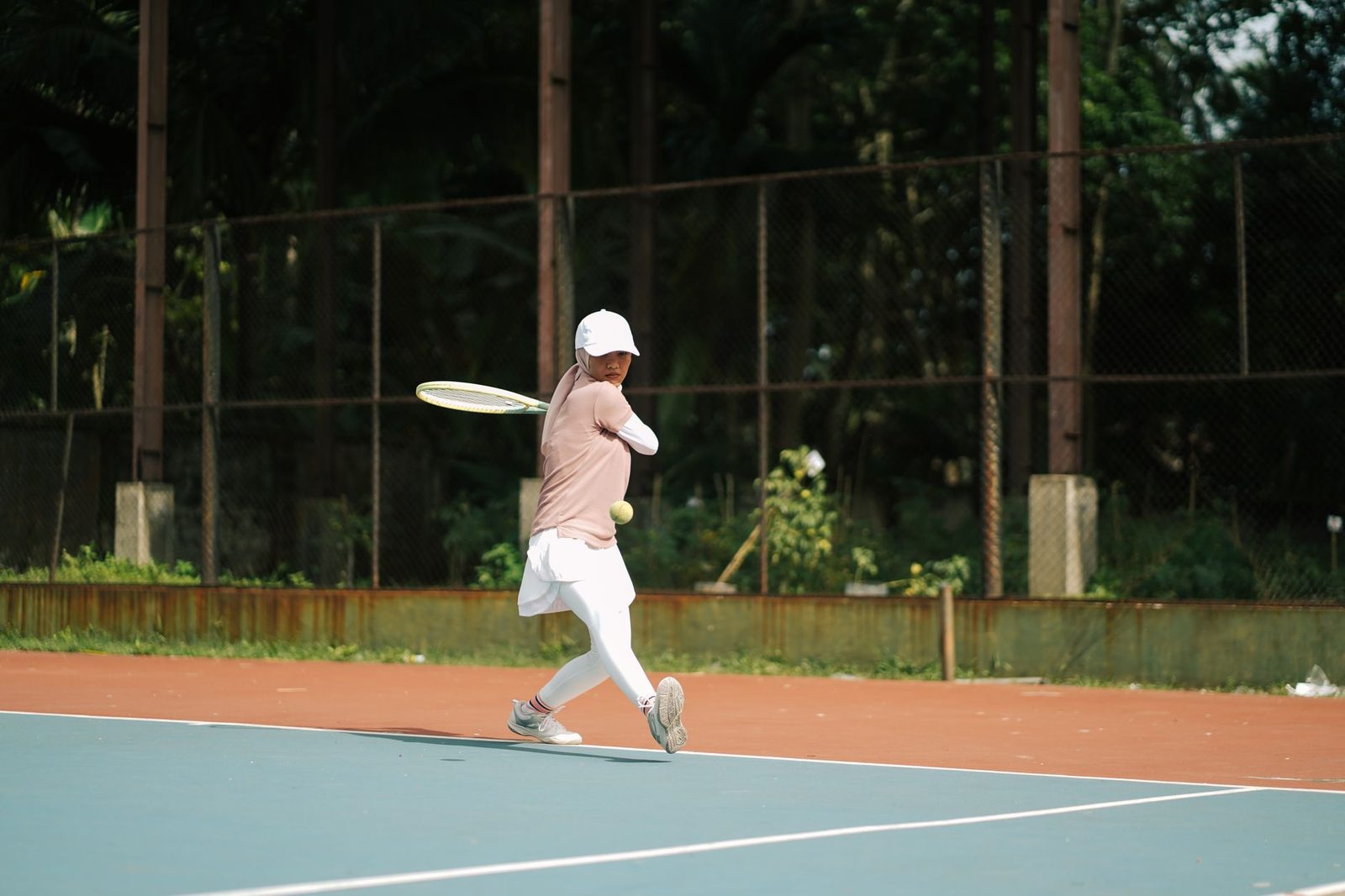
Every one-hander has to solve this, and it is the honest weakness of the shot. A ball above shoulder height cannot be struck in front with an extended arm in any comfortable way.
| Option | When | Trade-off |
|---|---|---|
| Take it early, on the rise | You are inside the baseline and set | Hardest option; needs excellent timing |
| Step back and let it drop | You have time and space | Cedes court position |
| Slice it | Most of the time, honestly | Defensive, but reliable and low |
| Drive it at shoulder height | Only if you are strong and well set | Low percentage for most players |
For nearly all club one-handers the honest answer is the slice, and that is not a failure. A good slice off a high ball is a genuinely useful shot, and the technique is in this slice backhand technique guide.
06Common faults
| Fault | What you see | Usual cause |
|---|---|---|
| Ball floats short | No depth or pace | Contact too close to the body |
| Spraying wide | Balls miss to the side | Shoulders opening before contact |
| Framing high balls | Mishits above shoulder height | Trying to drive what should be sliced |
| Weak against pace | Racquet pushed back on contact | Late preparation; wrist not firm |
| No topspin | Flat, long balls | Racquet not dropping below the ball |
Three of those five are preparation problems rather than swing problems, which is the pattern with this shot. Movement matters more here than on any other groundstroke, and these tennis footwork drills are the underpinning.
07Three drills
1. Contact point from the service line
Stand at the service line with a partner feeding gently. Hit only the contact and follow-through, with no backswing at all. Twenty balls. Starting close slows everything down and lets you feel where the ball has to be struck.
2. Shadow with the off hand
No ball. Turn, hold the throat with your non-hitting hand, swing, and let that hand travel backwards as the racquet goes forward. Fifteen repetitions. This builds the counterbalance that stops the shoulders flying open.
3. Crosscourt with a target
Rally backhand crosscourt to a cone or a chalk mark near the baseline. Depth is the measure. A one-hander that lands short is being struck too close to the body, and depth is the quickest way to see whether the contact has improved.
08One hand or two, honestly
If you are choosing, choose two hands. It is easier to learn, more stable, better on high balls and stronger on the return. Nearly every junior programme starts there for good reasons, as set out in this two-handed backhand technique guide.
Keep a one-hander if you already have one and it works, because switching costs a season for a benefit you may never recover. And if you love the shot and want it anyway, that is a perfectly good reason too. Fit In Tennis has a beginner-level breakdown of the grip and swing if you are starting from scratch.
09Frequently asked questions
An eastern backhand grip, with the base knuckle of the index finger on the first bevel for a right-hander. Some players use a slightly more extreme grip for extra topspin. A continental grip works for slice but not for a drive.
Yes, noticeably. It demands a more precise contact point, an earlier shoulder turn and more forearm strength than a two-hander. That is why almost every junior now starts with two hands and adds a one-hander later, if at all.
Because the contact point must be in front of the body and the arm has no second hand supporting it, a ball above shoulder height forces a weak, unsupported position. Most one-handers answer high balls with a slice rather than a drive.
Rarely worth it for an adult club player. Switching costs a season of disruption for a benefit most players never recover. Adding a reliable slice gives you most of the variety a one-hander offers at a fraction of the cost.
Greater reach on wide balls, a natural transition to slice and volleys because the grip family is the same, and more disguise on the approach. It also tends to be more comfortable when moving forward into the net.

Claire Carter
Former WTA Tour Professional & Teaching Pro
Claire Carter is a former WTA Tour professional and a full-time teaching professional at Bay Club Redwood Shores, where she has coached juniors and adults for more than twelve years.
More about ClaireImage credits: Josh Calabrese (Unsplash), Osman Demirkıran (Pexels), Ozan Yavuz (Pexels), Payam Zolfagharian (Pexels), RDNE Stock project (Pexels), Ridwan Nugraha (Pexels), cottonbro studio (Pexels). Photographs are illustrative.