
Tennis Tips
The Half Volley and Swinging Volley Explained
Two shots most club players avoid: the half volley off the bounce and the swinging volley out of the air. When each is the right choice, and how to hit them.

Jump to a section
Want to improve your game?
Private and group coaching with Claire Carter in Redwood Shores.
Book a lessonMore tennis guides
Technique, gear, fitness and match play, written from the coach’s chair.
Browse all guidesTwo shots sit either side of the ordinary volley, and most club players own neither. One you cannot avoid, so you should learn it. The other you can avoid entirely, and knowing when not to hit it is half the skill.
The half volley is played just after the bounce. The swinging volley is played out of the air with a full groundstroke swing. They are opposites in almost every respect.
01The half volley: what it actually is
A half volley is struck immediately after the bounce, while the ball is still rising. Timing is harder than an ordinary volley because you are meeting the ball at a moment you did not choose, and usually from below net height.
Crucially, it is almost never a shot you plan. It is what happens when you are moving forward and your opponent puts the ball at your feet. That means the question is not whether to hit one but how to survive it well.

02How to hit a half volley
- Continental grip, the same as your volley.
- Get low. Bend at the knees, not the waist, so your eyes drop to the ball’s level.
- Almost no backswing. The racquet is already in front of you.
- Slightly open racquet face, because you are lifting from below the net.
- Soft hands. You are cushioning the ball, not striking it.
- Follow through forward and low, and keep moving in.
The most common error is being too firm. A tight grip sends the ball long or into the net depending on the face angle, whereas a relaxed hand absorbs the pace and lets the ball drop over. It is the same soft-hand skill the drop shot needs, covered in this tennis drop shot guide.
03Where to aim it
| Situation | Target | Reason |
|---|---|---|
| Moving forward, ball at your feet | Deep down the middle | Buys time; removes their angle |
| Wide and stretched | Deep crosscourt | Longest part of the court; most margin |
| Opponent well back | Short and low, like a drop | The bounce is already low |
| Doubles, net player opposite | Low crosscourt | Keeps it away from the interceptor |
| Anything above waist height | Do not half volley | Take it as a normal volley instead |
That last row matters. If you can take the ball out of the air comfortably, do. The half volley is what you play when you cannot.
04The swinging volley: the opposite shot
Where the half volley is forced and defensive, the swinging volley is chosen and aggressive. You take a floating ball out of the air with a full groundstroke swing, usually from around the service line.
It solves a specific and very common problem. Your opponent hits a high, slow, floating ball while you are in the middle of the court. Your options are to retreat and let it bounce, giving up the ground you just gained, or to attack it in the air. The swinging volley is the second option.
05How to hit a swinging volley
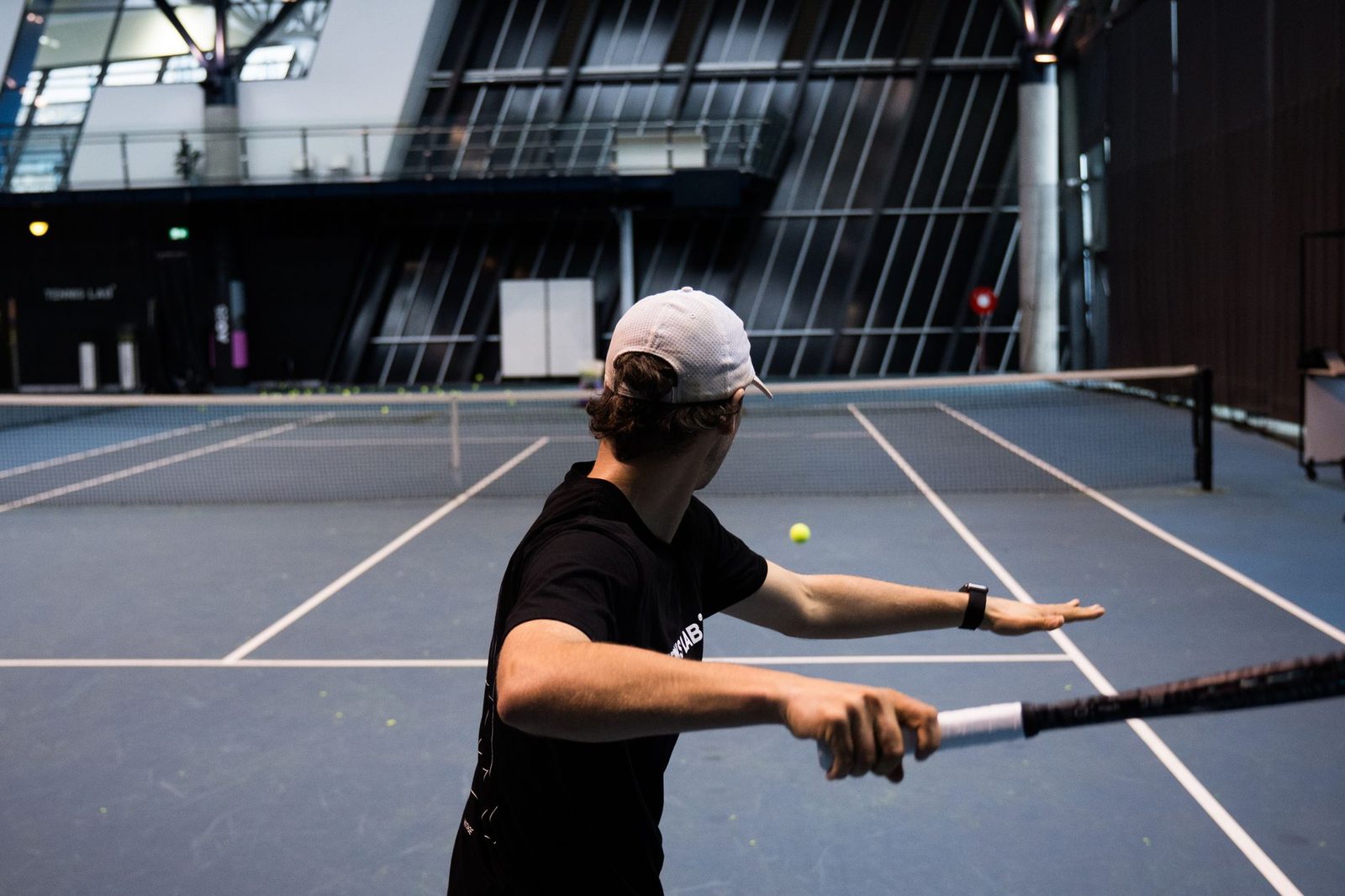
- Use your normal groundstroke grip, not continental. This is a groundstroke.
- Turn early. You have less time than a bounced ball gives you.
- Swing low to high with topspin. Spin is what keeps it in the court.
- Contact at roughly shoulder height, out in front.
- Aim crosscourt as a default; the net is lower and the court longer.
- Keep moving forward afterwards. You have just taken time away, so close in.
The topspin is not optional. A flat swinging volley from mid-court has almost no margin and will fly long. If your topspin forehand is unreliable, build that first using this complete guide to forehand technique.
06When to hit it, and when not to
| Ball you receive | Swinging volley? | Why |
|---|---|---|
| High, slow, floating, you are set | Yes | Time to prepare and swing fully |
| Weak lob falling short | Yes | Easier than an overhead from mid-court |
| Low ball | No | No room to swing up; volley it instead |
| Fast, driven ball | No | No time; block it or half volley |
| You are stretched or off balance | No | A full swing needs a stable base |
| Important point, shot untested | No | The margin is too small to gamble |
In doubles the swinging volley is particularly useful against a team that lobs a lot, because it lets you punish a short lob without retreating. The wider tactics for that are in this guide to beating a lobber.
07Two drills
1. Drop and guide, for the half volley
Stand near the service line. A partner drops a ball just in front of you; you let it bounce and guide it back low over the net with almost no swing. Twenty repetitions. The goal is feel, not depth.
2. Feed and attack, for the swinging volley
A partner feeds a high, floating ball to your forehand while you stand around the service line. Take it out of the air with a full topspin swing, crosscourt. Ten each side. Expect to miss several early; the margin is genuinely small.
08How they fit into your net game
Think of the three shots as a sequence rather than alternatives. As you move forward you might half volley the first ball because it lands at your feet, volley the second properly from a better position, and finish with a third. Or a float comes and you swing at it.
The half volley is the price of admission for approaching the net; the swinging volley is a bonus once you are comfortable there. Both sit on top of ordinary volley technique, which is in these tennis volley drills, and both depend on getting to the right place, which is in this approach shot and transition guide. WebTennis24 has a step-by-step half volley lesson if you want another reference.
09Frequently asked questions
A half volley is played immediately after the bounce, while the ball is still rising. It is not a volley in the strict sense, since the ball has bounced, and it is usually forced on you when a shot lands at your feet as you move forward.
A swinging volley is a full groundstroke swing taken at a ball out of the air, before it bounces. It is typically used on a floating ball while you are in the middle of the court, and it lets you attack instead of retreating.
Mostly, yes. You rarely choose to hit one; it is what you play when a ball arrives at your feet during the transition. The aim is to survive the shot and keep moving forward, not to win the point with it.
Usually because the racquet face is closed or the hands are too firm. You need a slightly open face and soft hands to lift the ball over the net from below its height, and almost no swing at all.
On a high, slow, floating ball when you are inside the baseline and have time to prepare. Never on a low ball, a fast ball, or when you are stretched, because the full swing leaves no margin.

Claire Carter
Former WTA Tour Professional & Teaching Pro
Claire Carter is a former WTA Tour professional and a full-time teaching professional at Bay Club Redwood Shores, where she has coached juniors and adults for more than twelve years.
More about ClaireImage credits: Babak Eshaghian (Unsplash), Dennis Schmidt (Unsplash), Erwan Hesry (Unsplash), Nenyasha Manzvera (Pexels), Ridwan Nugraha (Pexels), cottonbro studio (Pexels), Елена (Pexels). Photographs are illustrative.