
Serve
Why Do Tennis Players Bounce the Ball Before Serving?
Tennis players bounce the ball before serving to set rhythm, steady nerves and trigger a consistent routine. Here is the reasoning, the research and the rules.

Jump to a section
Want to improve your game?
Private and group coaching with Claire Carter in Redwood Shores.
Book a lessonMore tennis guides
Technique, gear, fitness and match play, written from the coach’s chair.
Browse all guidesTennis players bounce the ball before serving to trigger a consistent routine. Those few seconds regulate breathing, mark a clean break from the previous point, settle the grip and hands, and establish the rhythm the service motion will follow.
It looks like a nervous habit. It is closer to the opposite: a deliberate, rehearsed piece of preparation that most professionals repeat almost identically hundreds of times a match.
01The five reasons behind the bounce
1. It sets the rhythm
The serve is the only shot in tennis you start entirely on your own terms. Bouncing gives the body a tempo to sync with, so the toss and the swing arrive in the same rhythm they did in practice.
2. It steadies the nerves
A repeated physical action gives an anxious mind something narrow to hold on to. Under pressure, attention scatters. Counting bounces pulls it back to a single, controllable task.
3. It marks a boundary
The bounce separates the point that just finished from the point about to start. That psychological full stop is why you often see a player bounce longer after losing a big point.
4. It prepares the hands
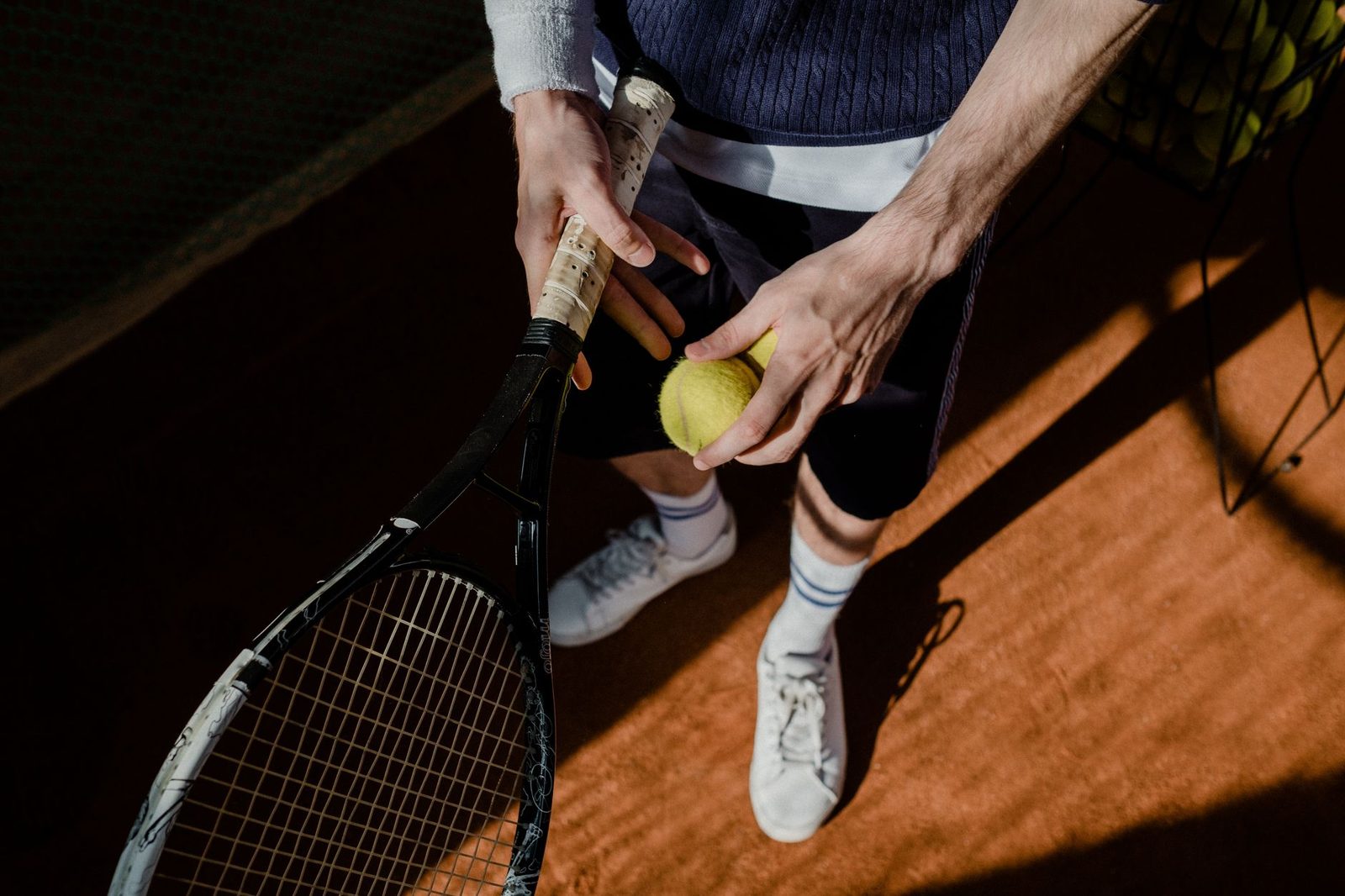
Those seconds let a player feel the ball, adjust grip pressure and check the racquet face. Small, practical adjustments that are far easier to make before the motion than during it.
5. It controls the pace of the match
Bouncing is also a tactical lever. A player who wants to slow an opponent’s momentum takes their time. A player riding a run of points gets on with it.
02What the research says about pre-serve routines
This is not folklore. Pre-performance routines are one of the better-supported ideas in applied sport psychology. Studies consistently find that athletes who use a consistent routine before a self-initiated skill perform more reliably than those who do not.
The mechanism is straightforward: routines help focus attention, reduce distraction and regulate arousal, and they appear to help whether the routine is simple or elaborate. Tennis is a textbook case, because the serve gives you a few uninterrupted seconds to prepare. A published examination of pre-service routines among elite tennis players found that top players are remarkably consistent in how they spend those seconds.
The number of bounces does not matter. The consistency of the number does.
03How long are you allowed to take?
Professional tennis uses a visible serve clock. Players have roughly 25 seconds between the end of one point and the start of the next, and bouncing counts against it. Take too long and the umpire issues a time violation.
| Level | Time between points | Practical effect on the routine |
|---|---|---|
| Professional tour events | About 25 seconds, shown on a visible clock | Routines are trimmed and rehearsed to fit reliably inside the limit |
| Sanctioned junior and adult tournaments | Typically 20 to 25 seconds, enforced by officials when present | Long routines risk warnings in officiated matches |
| League and club matches | Usually unenforced, but etiquette applies | Keep it brief enough that your opponent does not lose focus |
| Practice | No limit | The best place to build and lock in the routine you will use |
Second serves are the interesting case. The clock does not restart, so there is rarely time for a full routine. Most players shorten to a single bounce or a breath, which is worth practising deliberately rather than improvising.
04Building your own pre-serve routine
A good routine is short, repeatable under pressure, and identical every time. Four elements are enough.
| Step | What you do | What it achieves |
|---|---|---|
| 1. Reset | Turn away, adjust strings, take one breath | Closes the previous point |
| 2. Decide | Choose the target and the serve before you step up | Removes mid-motion hesitation |
| 3. Bounce | The same number of bounces, every single time | Sets rhythm and regulates breathing |
| 4. Go | Toss and swing without pausing | Prevents second-guessing at the worst possible moment |
- Pick a number between two and six. More than that is hard to sustain under a clock.
- Use the same number for every first serve, in practice and in matches.
- Build a shorter version for second serves, and rehearse it.
- If you catch a bad toss, restart the routine rather than rushing.

05Teaching the routine to juniors
Juniors adopt routines quickly and keep them for decades, which makes this one of the highest-value things to teach early. The trick is to introduce it as part of the serve itself, not as an optional extra bolted on afterwards.
In lessons I ask players to say their number out loud for the first few weeks. It sounds silly and it works. For juniors heading toward tournaments, the routine matters even more once matches start counting, which is where the junior tennis pathway in Northern California begins. Once the count is automatic, the serve stops falling apart the moment the score gets tight. You can see the full service motion broken down in the free tennis instructional videos, and if you want the mechanics built properly from the start, that is exactly what a private lesson in Redwood Shores is for.
06Does it actually help your serve?
Not directly. A routine will not add pace or fix a poor toss. What it does is protect the technique you already have from the effects of pressure, which is usually where club-level serves fall apart. If the mechanics themselves are the problem, start with this step-by-step tennis serve technique guide instead.
If your serve is mechanically inconsistent, the routine is the second problem to solve, not the first. Time on a wall works well for the rhythm side of it: the serve-and-recover exercise in these tennis backboard drills for solo practice lets you repeat the motion without chasing balls. And in doubles, serve quality is what makes everything else possible, since a jammed returner is the trigger for the whole complete guide to poaching in tennis doubles.
07Frequently asked questions
Players bounce the ball to trigger a consistent pre-serve routine. The bounces regulate breathing and heart rate, mark a clear transition from the last point to the next one, settle the hands and grip, and set the rhythm the service motion will follow. It is a deliberate performance habit rather than a nervous tic.
There is no standard. Most professionals settle on a personal number, commonly between two and eight bounces, and repeat it almost identically before every first serve. What matters is that the number stays consistent, not what the number is.
Yes. Professional events run a serve clock giving players roughly 25 seconds between points. Bouncing counts against that time, which is why players who take long routines sometimes receive time violations.
Usually fewer times, or not at all. The shot clock does not reset between first and second serve, so there is far less time available. Many players use a single bounce or a short breath instead.
Yes. A short, repeatable routine is one of the cheapest ways to improve serve consistency. Pick a number of bounces, use the same number every time, and let it become the signal that the point is about to start.

Claire Carter
Former WTA Tour Professional & Teaching Pro
Claire Carter is a former WTA Tour professional and a full-time teaching professional at Bay Club Redwood Shores, where she has coached juniors and adults for more than twelve years.
More about ClaireImage credits: Andrew Heald (Unsplash), Jim Sung (Unsplash), Mudassir Ali (Pexels), Patrick Case (Pexels), ROMAN ODINTSOV (Pexels), cottonbro studio (Pexels), flou gaupr (Unsplash). Photographs are illustrative.