
Quick Start
Tennis Terminology: A Glossary for New Players
Every tennis term a new player needs, from ace to unforced error: scoring language, shot names, court areas and the slang you will hear at a club.

Jump to a section
Want to improve your game?
Private and group coaching with Claire Carter in Redwood Shores.
Book a lessonMore tennis guides
Technique, gear, fitness and match play, written from the coach’s chair.
Browse all guidesTennis has more vocabulary than most sports and very little of it is intuitive. New players spend their first months nodding along to words like deuce, let, break point and unforced error without being entirely sure what any of them mean.
Here is the whole language in one place, grouped by where you will actually encounter it.
01Scoring language
| Term | Meaning |
|---|---|
| Love | Zero |
| Fifteen, thirty, forty | One, two and three points won in a game |
| Deuce | Forty-all; you must win two consecutive points from here |
| Advantage (ad) | The point won immediately after deuce |
| Ad in / ad out | Advantage to the server / to the receiver |
| Game point | A point which, if won, wins the game |
| Break point | A game point for the receiver |
| Set point / match point | A point which, if won, wins the set or the match |
| Tiebreak | First to seven points by two, played at six games all |
| Bagel | Slang for winning a set 6-0 |
The server’s score is always called first, so “thirty-love” means the server leads. The full mechanics of how games, sets and matches fit together are in this guide to tennis rules and scoring.
02Serving terms
| Term | Meaning |
|---|---|
| Ace | A serve the receiver does not touch |
| Fault | A missed first serve |
| Double fault | Both serves missed; the point is lost |
| Let | Serve clips the net and lands in; replayed |
| Foot fault | Touching the baseline before striking the serve |
| First strike | The serve plus the following shot, taken together |
| Kick serve | A heavy topspin serve that bounces high |
| Slice serve | A sidespin serve that curves away |
| Service box | The area the serve must land in |
Kick and slice serves are the two spin serves worth learning, and the mechanics are in this guide to slice and kick serves.
03Shot names
| Term | Meaning |
|---|---|
| Forehand | Struck on your dominant side, palm facing forward |
| Backhand | Struck on your non-dominant side, one or two hands |
| Volley | Struck before the ball bounces |
| Half volley | Struck immediately after the bounce |
| Groundstroke | Struck after the ball bounces, from the baseline |
| Slice | Backspin; the ball stays low |
| Topspin | Forward spin; the ball dips and kicks up |
| Lob | A high ball over an opponent at the net |
| Overhead / smash | A powerful overhead strike, usually off a lob |
| Drop shot | A soft shot landing just over the net |
| Approach shot | A shot hit while moving forward to the net |
| Passing shot | A shot hit past an opponent at the net |
| Winner | A shot your opponent does not touch |
04Doubles-specific vocabulary
| Term | Meaning |
|---|---|
| Net player | The partner positioned at the net during a point |
| Poaching | Crossing the middle to intercept a ball meant for your partner |
| I-formation | Serving formation with the net player crouched at the centre |
| Australian formation | Serving formation with both players on the same side |
| Two up / two back | Both partners at the net, or both at the baseline |
| Switch | Partners swapping sides mid-point, usually after a lob |
| Hand signals | Pre-serve signals from net player to server |
Almost all of these appear in a single service game of club doubles, and none of them are explained to newcomers. The tactical meaning behind them is in this doubles court positioning.
05Court areas
- Baseline: the back line of the court.
- Service line: the line marking the back of the service boxes.
- Centre mark: the small mark dividing the baseline in two.
- Tramlines / alleys: the side corridors, in play only in doubles.
- Deuce court: the right-hand side as you face the net.
- Ad court: the left-hand side as you face the net.
- No-man’s-land: the awkward area around the service line.
- The T: where the centre service line meets the service line.
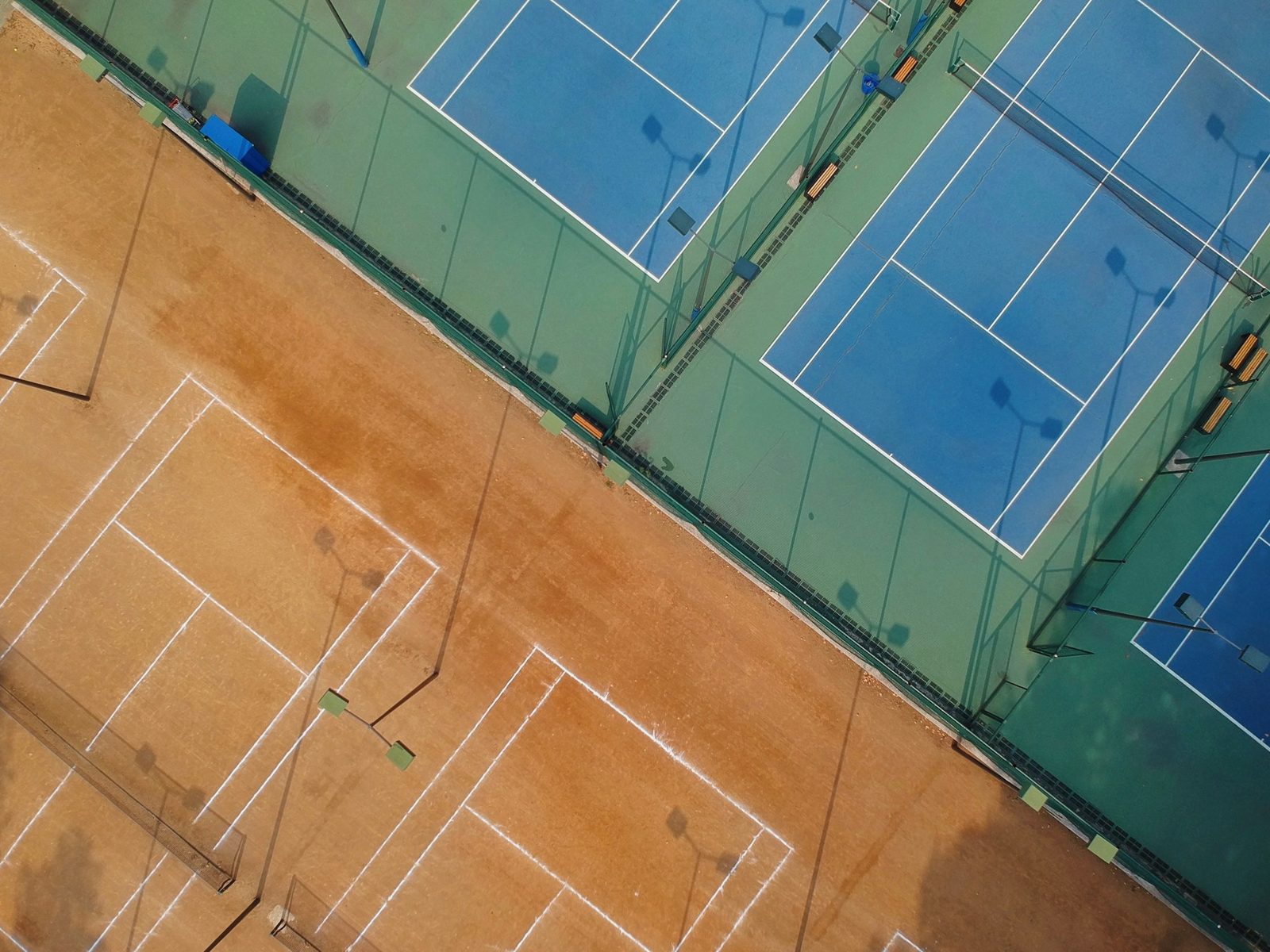
Deuce court and ad court are named for where those scores are played from, which is worth knowing because opponents will call serves by court rather than by side.
06Match and tactical language
| Term | Meaning |
|---|---|
| Unforced error | A miss with time and balance and no real pressure |
| Forced error | A miss caused by a good shot from your opponent |
| Hold serve | Winning your own service game |
| Break back | Winning a game on your opponent’s serve after losing yours |
| Changeover | The break when players switch ends |
| Rally | An exchange of shots within a point |
| Poach | Crossing at the net in doubles to intercept |
| Pusher | A player who wins by consistency rather than aggression |
| Moonball | A very high, slow, deep groundstroke |
Poaching and pushers both have their own guides: doubles court positioning and how to beat a pusher.
07Equipment and admin
- Gauge: string thickness; lower numbers are thicker.
- Tension: how tightly strings are strung, in pounds.
- Overgrip: a thin wrap over the handle grip.
- Head size: the racquet face area in square inches.
- NTRP: the USTA rating scale used for adult leagues.
- UTR: a separate global rating from 1.00 to 16.50.
- Pressureless: balls with no internal air pressure; last far longer.
The rating systems are explained in this USTA leagues and NTRP ratings explained, and the equipment terms in these guides to guide to choosing a tennis racquet and guide to tennis strings. For a second reference on general terminology, NBC Olympics maintains a broad tennis glossary.

08Calls and etiquette phrases
- “Out”: called immediately and clearly when a ball lands beyond the line.
- “Let” or “play a let”: replay the point.
- “Take two”: an offer of two serves after an interruption.
- “Yours” / “mine”: doubles calls for who takes the ball.
- “Switch”: partners are changing sides mid-point.
- “Not up”: the ball bounced twice before it was struck.
In club tennis there is no umpire, so these calls are how the game runs. The conventions around who calls what are covered in this guide to tennis rules and scoring.
09Do not worry about learning it all
Nobody sat down and memorised this. You pick it up by playing, and the terms that matter arrive naturally in the order you need them: scoring first, then shot names, then the tactical vocabulary.
If you are just starting, the scoring section above and these tennis drills for beginners will cover everything you need for your first month on court.

10Frequently asked questions
Zero. It appears in scores such as fifteen-love or love-forty. The most repeated explanation is that it derives from the French word for egg, l’oeuf, because a zero resembles an egg.
A serve that touches the net cord and still lands in the correct service box. It does not count as a fault and the serve is replayed. The word is also used more generally for any point that has to be replayed.
A fault is a missed first serve; you get a second attempt. A double fault is when the second serve also misses, and it loses you the point immediately.
Winning a game in which your opponent was serving. Because the server is expected to win their own service games, a break is a significant advantage and usually decides sets.
A mistake made when you had time and balance and no particular pressure from your opponent. It is distinguished from a forced error, where a good shot from the other side caused the miss.

Claire Carter
Former WTA Tour Professional & Teaching Pro
Claire Carter is a former WTA Tour professional and a full-time teaching professional at Bay Club Redwood Shores, where she has coached juniors and adults for more than twelve years.
More about ClaireImage credits: Ben Hershey (Unsplash), Gera Cejas (Pexels), Mobina Ranjbar (Unsplash), RDNE Stock project (Pexels), Wussol (Pexels), 傅甬 华 (Unsplash). Photographs are illustrative.