
Practice
How to Use a Tennis Ball Machine Effectively
Get more from a tennis ball machine: settings, six drills that transfer to matches, session length, and the mistakes that groove bad habits.

Jump to a section
Want to improve your game?
Private and group coaching with Claire Carter in Redwood Shores.
Book a lessonMore tennis guides
Technique, gear, fitness and match play, written from the coach’s chair.
Browse all guidesA ball machine is the most efficient practice tool most club players never use properly. It removes the two things that limit practice most: needing a partner, and the low number of balls you actually hit in an hour of rallying.
It also has one significant danger. A machine repeats faithfully whatever you ask of it, including your mistakes. Used without a plan it is an expensive way to practise a bad forehand three hundred times.
01Set it up properly first
| Setting | Start here | Why |
|---|---|---|
| Speed | Half to three-quarters of match pace | Rushed swings groove tension |
| Feed rate | Slow enough to recover fully between balls | You should not be scrambling |
| Height | Waist height at your contact point | The zone you actually want to master |
| Spin | Light topspin | Closest to a real rally ball |
| Oscillation | Off at first, on once the stroke holds | Add movement after technique |
| Balls | Pressureless | Pressurised balls flatten quickly in a machine |
The temptation is to turn the speed up because it feels more like a real rally. Resist it. You are not testing yourself, you are building something, and pace is the last variable to add.
02Six drills that transfer
1. Static groove
Machine feeding to one spot, no oscillation. Hit twenty forehands focusing on one cue only, such as contact point or finish. Then twenty backhands. This is the foundation and it is worth ten minutes at the start of every session.
2. Adjustment step
Same static feed, but after every shot you recover to the centre mark, split step as the machine fires, and move back out. This adds the footwork the static drill deliberately leaves out, and it is the drill most players skip.
3. Two-line oscillation
Turn oscillation on so the machine alternates forehand and backhand. Focus on light, quick steps and crossing your feet properly on the wider balls. Thirty seconds on, thirty off, six rounds.
4. Depth targets
Place a rope or a line of cones three feet inside the baseline and try to land every ball behind it. Count out of twenty. Depth is the single most useful measurable in groundstroke practice and it is easy to score.
5. Approach and volley
Set a short feed, hit an approach shot, then move in and volley the next ball. Some machines can be programmed for this; otherwise use a slow feed rate and move on your own count. This trains the transition covered in this approach shot and transition guide.
6. Rapid-fire volleys
Move to the service line with a fast feed rate and low speed. Continuous volleys, alternating sides, compact punches only. Thirty seconds on, thirty off. It pairs directly with these tennis volley drills.
03Structure a session
| Time | Focus | Setting |
|---|---|---|
| 0 to 10 min | Warm-up and static groove | Slow, no oscillation |
| 10 to 20 min | Adjustment step drill | Static feed, full recovery |
| 20 to 32 min | Two-line oscillation | Oscillation on, medium pace |
| 32 to 42 min | Depth targets | Medium pace, scored |
| 42 to 48 min | Volleys or approach work | Fast feed, low speed |
| 48 to 50 min | Easy balls, cool down | Slow |
Two or three of these a week is plenty. Beyond that, fatigue starts degrading technique faster than repetition improves it.
Decide the session’s single focus before you switch the machine on, and write it down if that helps. “Contact point out in front” is a session. “Improve my forehand” is not, and it usually turns into an hour of hitting balls with no particular outcome.
04Buying versus renting
A machine is a significant purchase, and for most club players renting occasionally makes more sense than owning.
| Buying | Renting or club machine | |
|---|---|---|
| Cost | Roughly $800 to $2,000 upfront | Often around $20 per hour |
| Convenience | Available whenever you are | Depends on booking and availability |
| Transport | Heavy; needs a car and a lift onto court | Usually stored at the club |
| Maintenance | Batteries, servicing, storage | Not your problem |
| Worth it if | You practise solo twice a week or more | You use it occasionally |
The break-even point is roughly forty to sixty hours of use, so the honest question is whether you will genuinely practise alone that often. Plenty of machines end up in garages after an enthusiastic first month.
05The mistakes that waste a session
- Standing still. If you are not moving your feet between balls, you are training half a stroke.
- Too fast a feed rate. Rushing produces tense, shortened swings.
- Full pace throughout. Save it for the final few minutes, if at all.
- No goal for the session. Decide one thing to work on before you switch the machine on.
- Grooving a fault. If you are not sure the technique is right, confirm it before drilling it hundreds of times.
That last one is the important one. A machine amplifies whatever you bring to it, which is why a session or two with a private lesson in Redwood Shores before a block of machine practice usually pays for itself.
06Machine, wall or partner?
| Ball machine | Wall | Hitting partner | |
|---|---|---|---|
| Cost | High to buy; often rentable by the hour | Free | Court time only |
| Setup | Transport, batteries, loading | None | Scheduling |
| Varied depth and spin | Yes | No | Yes |
| Reaction speed | Good | Excellent at close range | Good |
| Trains reading an opponent | No | No | Yes |
| Best for | Drilling one shot; depth control | Volleys, timing, volume | Tactics and pressure |
If cost is the deciding factor, the wall wins comfortably and these tennis backboard drills give you a full session structure. There is a useful primer on machine practice here if you are deciding whether to buy or rent.
07Practical details people forget
- Charge the battery the night before. Sessions die at the forty-minute mark otherwise.
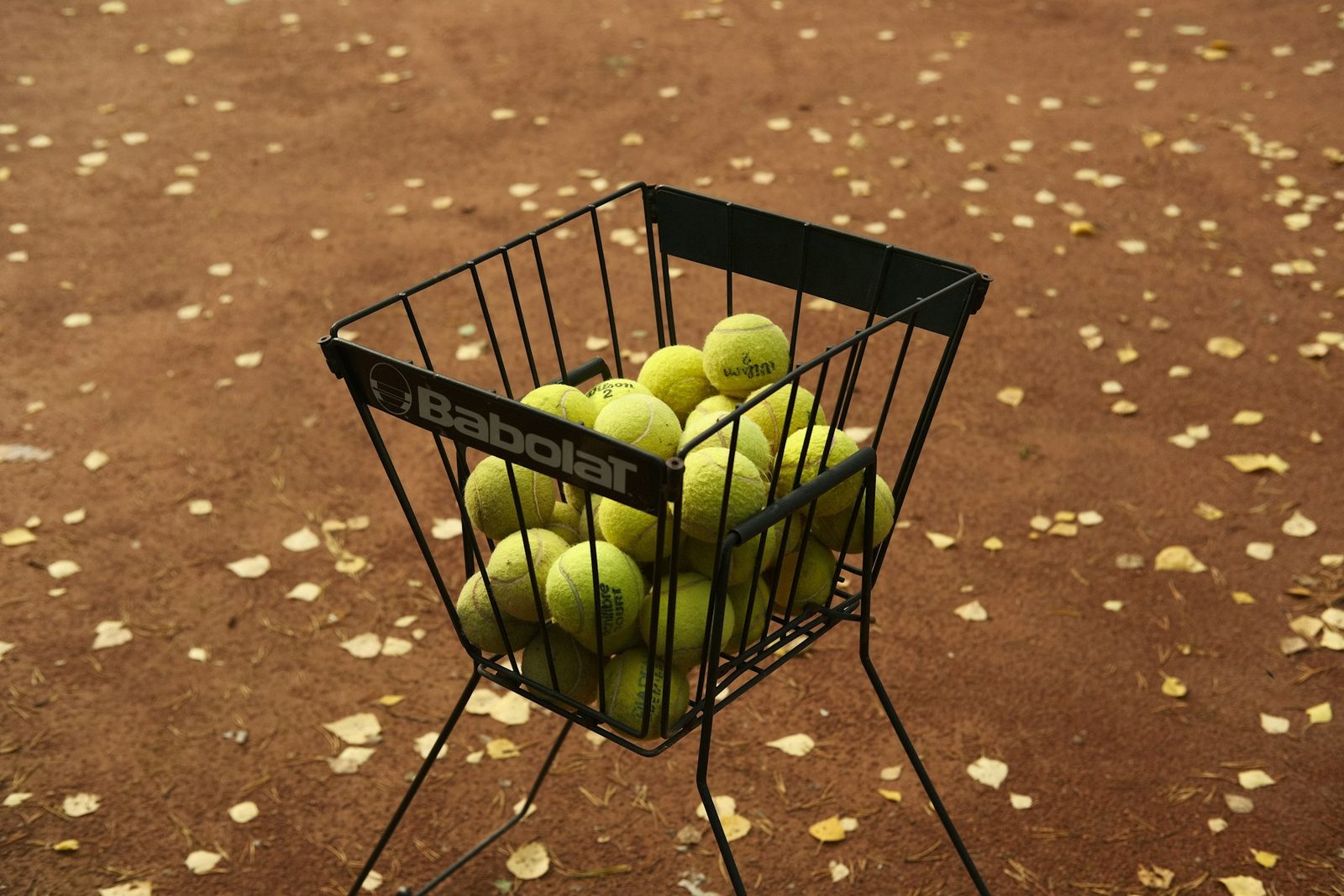
- Bring a hopper. Collecting balls by hand eats a third of your court time. The full comparison of ball types, and why pressureless matters for machines, is in this guide to tennis balls.
- Take a two-minute break while reloading, and stretch rather than standing still.
- Check your club’s rules; some restrict machine use at peak times.
- Log what you worked on. Sessions blur together otherwise.
08Frequently asked questions
Around 45 to 60 minutes, two or three times a week, is a sensible target. Longer than that and fatigue degrades your technique, which means you are grooving a worse version of the stroke you came to improve.
Around half to three-quarters of match pace for technical work. Full pace forces rushed, tense swings. Speed is the last thing to add, after contact point and footwork are reliable.
Pressureless balls. Standard pressurised balls go flat quickly under the squeezing pressure of the machine’s wheels, and they are more expensive to keep replacing.
They train different things. A machine gives varied depth, height and spin, and lets you drill a specific shot repeatedly. A wall is free, needs no setup and returns the ball faster, which is better for volleys and reaction work.
No. A machine repeats what you tell it, including your faults. It is excellent for grooving a technique you already know is correct, and it will just as happily groove a bad one several hundred times.

Claire Carter
Former WTA Tour Professional & Teaching Pro
Claire Carter is a former WTA Tour professional and a full-time teaching professional at Bay Club Redwood Shores, where she has coached juniors and adults for more than twelve years.
More about ClaireImage credits: Ben Hershey (Unsplash), Cameron J. (Unsplash), RDNE Stock project (Pexels), Richard Sagredo (Unsplash), Shamil Khasaev (Unsplash), Tahamie Farooqui (Unsplash), cottonbro studio (Pexels). Photographs are illustrative.