
Off-Court
Tennis Mental Game: Staying Calm When the Match Tightens
Practical tennis mental game strategies: a between-point routine, breathing, handling pressure points and why most choking is a focus problem, not nerves.

Jump to a section
Want to improve your game?
Private and group coaching with Claire Carter in Redwood Shores.
Book a lessonMore tennis guides
Technique, gear, fitness and match play, written from the coach’s chair.
Browse all guidesEvery club player has lost a match they should have won. The strokes were the same as in practice, the opponent was beatable, and somewhere around 4-4 in the second set it all came apart.
That is not a technique problem and it is not a character flaw. It is an attention problem, and attention is trainable. Here is what actually works, with none of the motivational filler.
01What choking actually is
Under pressure, most players do not forget how to hit a forehand. What changes is where their attention goes. Instead of the ball, it goes to the score, the consequences, and what happens if they miss.
Most of the tension that looks like nerves comes from thinking ahead of the current point. You cannot play a set. You can only play the next ball, and the mental skills that matter are the ones that keep returning you to it.
You cannot play the score. You can only play the next ball.
02The between-point routine
This is the single highest-value mental tool in tennis, and almost nobody at club level uses one deliberately. You have roughly twenty seconds between points. Used well, it resets you. Used badly, it lets the last point contaminate the next one.
| Stage | What you do | Purpose |
|---|---|---|
| 1. Respond | One physical gesture, positive or neutral | Acknowledge the point and close it |
| 2. Relax | Turn away to the back fence, breathe out slowly | Lowers heart rate; physically separates the points |
| 3. Plan | One tactical thought, no more | Gives attention something concrete |
| 4. Ready | Step to the line and commit | Removes hesitation at the worst moment |
The turn away matters more than it sounds. Physically facing the back fence between points creates a boundary, and it is what stops a bad game becoming a bad set.
03Breathing, specifically
Slow breathing with a longer exhale than inhale is a physiological intervention, not a relaxation cliché. In for roughly four counts, out for six, twice between points. It lowers heart rate and interrupts the tension spiral before it reaches your hands.
Practise it in training, not only in matches. Nowhere tests this more than a first tournament, and this guide to playing your first tennis tournament covers what that day is actually like. A technique you have never used when calm will not appear when you are tight.

04Handling the specific pressure moments
| Moment | The trap | What to focus on instead |
|---|---|---|
| Serving for the set | Thinking about winning it | First serve percentage and one target |
| Break point against you | Playing not to lose | A specific serve to a specific spot |
| After a bad miss | Replaying it | The routine; respond, breathe, plan |
| Opponent is cheating on line calls | Arguing and losing focus | Play the ball; raise it once, calmly, then move on |
| Big lead slipping | Protecting the lead | Return to the pattern that built it |
| Losing badly | Giving up | One tactical experiment per game |
05The pre-match routine
A lot of what happens at 4-4 is decided before the match starts. What you ate and drank beforehand is part of that too, as set out in tennis nutrition and hydration. Turning up rushed, underfed and without a plan means you spend the first four games settling, and against a decent opponent those four games are gone.
| When | What | Why |
|---|---|---|
| 60 min before | Eat something light; arrive unhurried | Removes avoidable stress |
| 30 min before | Dynamic warm-up, not stretching | Raises temperature and switches the body on |
| 15 min before | Hit, starting short and building | Grooves timing before it matters |
| 5 min before | Decide two tactical intentions | Gives attention somewhere to go |
| First game | Play the patterns, not the score | Settling early is worth a break of serve |
Two intentions is the right number. One is too vague to act on and five is a checklist you will abandon by the second game. Something like “first serve percentage” and “deep to the backhand” is concrete enough to follow when the match tightens.
06Body language is not cosmetic
How you carry yourself between points feeds back into how you feel. Head up, shoulders back and a brisk walk to the baseline is not about impressing your opponent. It changes your own physical state, and it denies them the information that you are struggling.
- Never show the racquet-down slump. It tells your opponent to keep doing what they are doing.
- Walk at the same pace whether you won or lost the point.
- Keep the same routine at 5-1 up as at 1-5 down.
- Save the analysis for after the match. Mid-match diagnosis is rarely accurate.
07What to do with frustration
Frustration is not the problem. Trying to suppress it is, because suppression takes attention, and attention is exactly what you need for the next point.
There is also a difference between frustration at a shot and frustration at yourself. The first is information: you missed something you can normally make, and it is worth a moment of attention. The second is just noise, and it compounds. Learning to separate them is most of what people mean by mental toughness.
Give it a channel instead: a short exhale, a word to yourself, then the routine. Players who never look frustrated are not calmer than you, they have simply rehearsed what to do with it.

08Teaching this to juniors
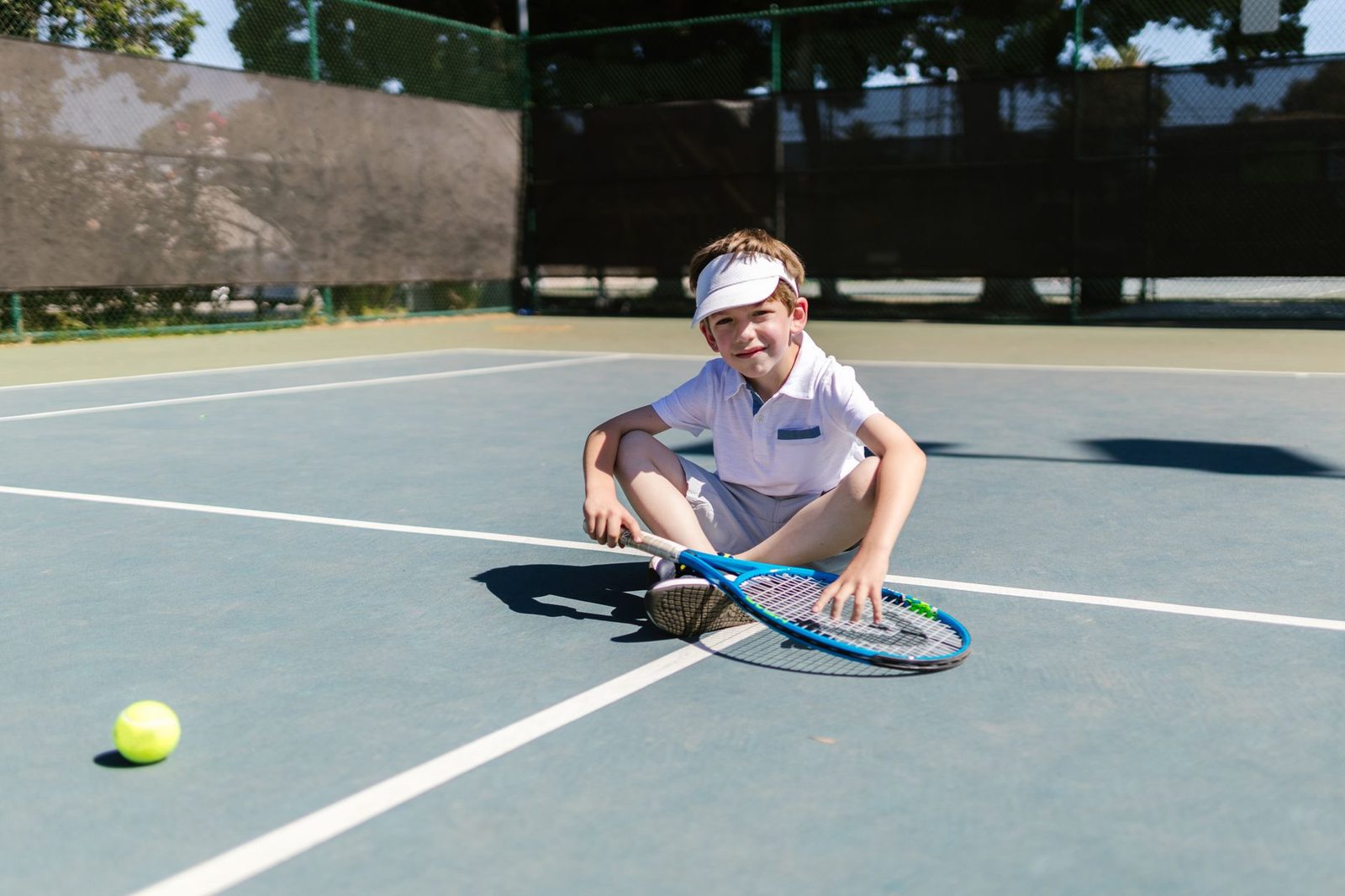
Juniors adopt mental habits fast and keep them for decades, which is an argument for teaching the routine early rather than treating it as advanced material.
Keep it concrete. “Turn to the back fence and breathe out” is coachable. “Stay positive” is not. The pre-serve version of this is covered in the pre-serve bounce routine, and it is the easiest entry point because the routine attaches to something they already do.
For a deeper treatment of critical points, the sports psychology work on mindset at critical points is worth reading. Tactically, having a plan to fall back on reduces pressure considerably, which is why singles strategy and point construction and mental steadiness tend to improve together.
09Frequently asked questions
Usually because attention shifts from the task to the outcome. In practice you think about the ball; in a match you think about the score, the result and what people think. A between-point routine is the practical tool that brings attention back to the immediate task.
A short, repeatable sequence you run after every point: a physical response, a turn away and a breath, one tactical thought, then a decision. It takes about fifteen seconds and it stops the previous point leaking into the next one.
Narrow your focus to something concrete and controllable, such as a serve target or the depth of your next ball. Choking is rarely about nerves themselves; it is about attention drifting to the consequences instead of the shot.
Yes. Slow breathing with a longer exhale than inhale, for example in for four and out for six, lowers heart rate and interrupts the physical spiral of tension. It works because it is a physiological intervention rather than a motivational one.
Shorten your horizon. Stop thinking about the set and play one point with one clear intention. Losing a lead usually means the plan quietly changed from playing well to not losing, and the fix is returning to a specific tactical goal.

Claire Carter
Former WTA Tour Professional & Teaching Pro
Claire Carter is a former WTA Tour professional and a full-time teaching professional at Bay Club Redwood Shores, where she has coached juniors and adults for more than twelve years.
More about ClaireImage credits: Gaspar Zaldo (Pexels), Ile Gorgievski (Unsplash), Julie Sd (Unsplash), RDNE Stock project (Pexels), cottonbro studio (Pexels), gaspar zaldo (Unsplash). Photographs are illustrative.