

Choosing a tennis coach is mostly guesswork for people who have never had lessons. The rates look similar, everyone’s website says the same things, and it is hard to judge quality until you have already paid for several hours.
There are reliable signals, though. Some are on paper, most are visible within the first twenty minutes of a lesson, and a few only show up after a month.
What certification actually tells you
In the United States, the two recognised bodies are the USPTA and the PTR. Both require assessed training and ongoing education, and both maintain public directories where you can confirm a coach’s status is current.
Certification is a floor, not a ceiling. It tells you someone has been assessed against a standard and takes the profession seriously. It does not tell you they can fix your backhand. You can check any coach’s standing through the USPTA directory, and any coach who hesitates when you mention verifying is telling you something useful.
| Credential | What it means | What it does not tell you |
|---|---|---|
| USPTA or PTR certification | Assessed training, continuing education, insurance | Whether they can teach your specific problem |
| Tour or college playing record | Deep understanding of the game at speed | Whether they can explain it to a beginner |
| Safeguarding and first aid | Essential for anyone coaching juniors | Coaching quality |
| Years of experience | Pattern recognition; they have seen your fault before | Whether they have kept learning |
| Results with comparable players | The strongest single signal | Very little else |

Questions worth asking before you book
- What is your experience with players at my level and age?
- What is your coaching philosophy: technique first, or match play first?
- How will we measure whether this is working?
- What will you expect me to do between lessons?
- Are you certified, and with which body?
- Does your rate include court fees, and what is the cancellation policy?
The third question is the one that separates coaches. Someone who can describe what progress should look like in six weeks has thought about your development. Someone who cannot is selling court time.
What a good first lesson looks like
You can learn most of what you need from a single trial session. Watch for these things rather than whether you enjoyed it, because enjoyable and useful are not the same.
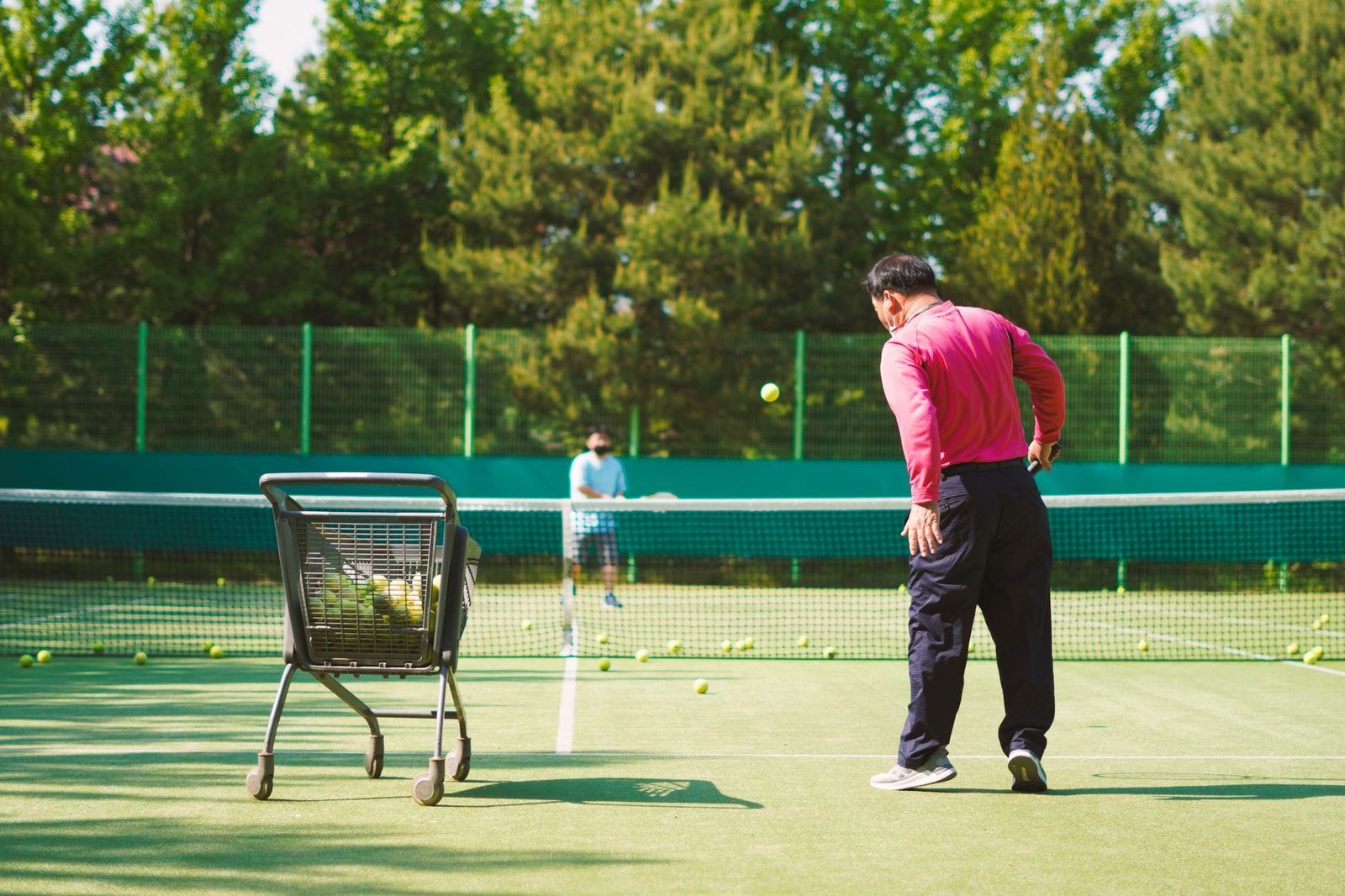
- They spend the first ten minutes watching you hit before changing anything.
- They give you one or two focus points, not a full technical audit.
- They explain why a change matters, not only what to do.
- They feed enough balls that you actually get repetitions.
- You leave knowing exactly what to practise before next time.
Red flags
| Red flag | What it usually means |
|---|---|
| Changes five things in the first lesson | Coaching a checklist, not a player |
| Talks more than you hit | You are paying court rates for a lecture |
| Cannot explain why a change helps | Copying a method without understanding it |
| Evasive about certification or insurance | Verify before booking anything further |
| Same drill every week regardless of progress | No plan behind the sessions |
| Coaches juniors with no safeguarding training | Walk away |
Matching the coach to the player
Compatibility matters more than most people expect, and it is not the same as liking someone. Some players need encouragement to take risks; others need to be held to a standard. A mismatch here undermines even excellent technical coaching.
For juniors the requirements are different again. Coaching children well means managing attention spans, building enjoyment that survives losing, and developing technique that still works when they are eighteen. Ask about the age group specifically. Someone excellent with competitive adults may be poorly suited to eight-year-olds, and vice versa.
Private, group or both?
The format matters as much as the coach. Private lessons change technique fastest; group sessions build volume, pressure and enjoyment. Most improving players do best with a mix, and the honest cost comparison is set out in this guide to tennis lesson costs in the Bay Area.
One practical note: a coach who is excellent one-to-one is not automatically good at running a group, and the reverse is also true. Managing eight players of differing levels while keeping everyone hitting is a genuine skill. If you intend to do both formats, it is worth watching a group session before signing up.

How to tell whether it is working
Progress in tennis is not linear, and it usually feels worse before it feels better, because a change in technique disrupts what you could already do. That makes it easy to quit a good coach too early and stay with a poor one too long.
| Signal | Good sign | Concerning |
|---|---|---|
| Technical change | The new pattern shows up unprompted | Still needing reminders every ball |
| Match play | Losing points differently than before | Identical errors to two months ago |
| Between lessons | You know what to practise | You cannot remember what to work on |
| Confidence | Willing to attempt the shot under pressure | Avoiding it entirely in matches |
Give a technical change six to eight weeks before judging it. Give a coach who cannot explain the plan considerably less.
Coaching on the Peninsula
If you are reading this from the other direction and thinking about coaching as a career yourself, how to become a tennis coach covers the certification routes. I coach at Bay Club Redwood Shores, working with juniors on the competitive pathway, adults rebuilding technique, and players who simply want to enjoy the game more. Before booking anything, you can get a clear sense of how I teach from the free tennis instructional videos, which is a fairer test than any website copy.
If you are weighing up a junior programme, the junior tennis pathway in Northern California explains where the pathway leads. Facility details are on the Bay Club Redwood Shores locations page, and a private lesson in Redwood Shores is the quickest way to arrange a first session.
Frequently asked questions
What certifications should a tennis coach have?
In the United States, USPTA and PTR are the two recognised certifying bodies. Both involve assessed training and continuing education. You can verify any coach’s current status through the official directories on their websites, and a legitimate coach will happily give you their certification number.
Is certification more important than experience?
No, but it is a useful floor. Certification shows a coach has been assessed against a standard; experience shows they can diagnose a fault and fix it. The strongest signal is a track record with players similar to you in age and level.
How do you know if a tennis coach is any good?
They watch more than they talk, they give you one or two things to work on rather than ten, they explain why a change matters, and they can tell you what progress should look like in six weeks. If you leave a lesson unsure what to practise, that is a bad sign.
Should a junior have the same coach as an adult beginner?
Not necessarily. Coaching children well requires different skills: managing attention, building enjoyment and developing technique that will still work in ten years. Ask specifically about experience with the age group, not just the level.
How long should you stay with a coach?
As long as you are improving and enjoying it. Review honestly every few months. Changing coach because you have plateaued is reasonable; changing every time a lesson is hard usually is not.
Written by Claire Carter, a former WTA Tour professional and full-time teaching pro at Bay Club Redwood Shores, where she has coached juniors and adults for more than twelve years.
Image credits: Ahmed (Unsplash), Hermes Rivera (Unsplash), Marsha Reid (Unsplash), RDNE Stock project (Pexels), Ridwan Nugraha (Pexels), Stephen Kim (Pexels). Photographs are illustrative.